VIOLIN
“The magnificent sound of her violin, the mastery of gently constructing the melody, the power and depth of the play, the scale of the performance - all these are typical only for a talented performer."
/Maxim Shostakovich, conductor/
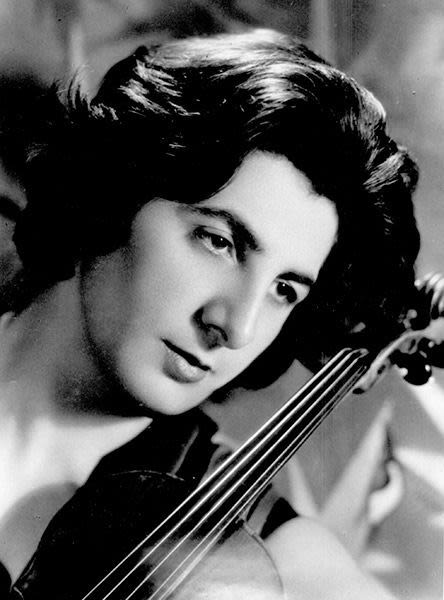
Performing art had a special place in Anahit Tsitsikian's fruitful creative career. She was the first Armenian female violinist to receive international recognition. She has performed more than 1000 times in Armenia and abroad, with group concerts, as a solo, with a symphony orchestra in large concert halls, in the open air - in faraway regions of Armenia. She had many recordings, which are kept in the national archives of Armenian radio, also she released the first vinyl record of Armenian violin music (Moscow, 1962, "Melodia" recording studio).
Her teachers were followers of the famous Auer school: Gregory Ginsburg, Lev Tsaitlin, Constantine Mostras and Karp Dombayev. That fact played a crucial role in forming her performing style. The best features - delicate taste and lyricism of the Russian violin school were surprisingly combined with, the oriental color and the fiery of Armenian temperament.
Having successfully played almost the entire classical repertoire, Anahit Tsitsikyan gradually referred to Armenian music more and more often. She has been performing the works of Khachatryan, Spendiaryan and Tigranyan since her school years. "With the best wishes for the flourishing of your talent," Aram Khachatryan wrote on the notes dedicated to the young performer of his "Concert".
Later, Anahit Tsitsikyan's concert programs always dominated with the works of Armenian authors․ The promotion of Armenian music gradually became the main goal of her life. "Everyone plays Mozart and Beethoven, and who, if not Armenians, should play our music?" said the violinist. She often was inspiring young Armenian composers․ contributing to the creation of new works, being their first performer (more than 40 works), editor, and sometimes even co-author. Many composers have dedicated their new works to Anahit Tsitsikyan (Artemi Ayvazyan, Erik Harutyunyan, Grigor Hakhinyan, Edward Baghdasaryan, Arzas Voskanyan, Yuri Ghazaryan, John Kirakosyan, Melik Mavisakalyan, Gagik Hovunts, Harvand Sardaryan, Yervand Sardaryan).
During a recording in Moscow, the Russian composer Klebanov, admiring the incomparable music of the violinist, says to Erik Harutyunyan during the conversation. "You can write music endlessly because you have such a performer."
Throughout her career, Anahit Tsitsikyan stood out as a persona with a searching temperament, constantly disposed to innovation. In an effort to diversify her repertoire with interesting unique pieces, she performs works of European composers (A. Corelli, A. Vivaldi, J. Tartini, P. Locatelli, Bach, Handel). Ordinary duets (violin-guitar, violin-organ), organizing thematic concerts ("Italian music of the XVIII century", "Armenian medieval music"). Due to her efforts, long searches in the archives, previously unknown works received new life. This is how the "Ancient and Modern Melodies of Armenia" program was born, where among other works were Nerses Shnorhali's poems and Makar Yekmalyan's liturgy adapted for the violin.
A new genre unusual for Armenia, such as the Concert-Lecture was developed, where during the course of the events - Anahit Tsitsikian shone equally as a master of speech and music.
Anahit Tsitsikian was accompanied by Marianna Harutyunyan, Neli Daniel-Bek, Eleonora Voskanyan, Hovhannes Parajanyan, Naum Walter. She played with conductors such as: Constantine Sarajev, Michael Maluntsian, Kurt Zanderling, Ohan Durian, Igor Blazhkov, Algis Juraitis, Earl Defonseca, Rafael Mangasaryan, David Khanjyan, Maxim Shostakovich, Ivan Vulpen, Tomislav Sopovsky and others.
Anahit’s Violin:
When Anahit graduated from the conservatory in the early 50s and had to return the collection violin, there was a need to buy her own instrument. Just at that moment she was offered the violin of a "little-known" master and the bow of François Tourte. The violin was the work of an 18th century master - Antonio Graniani from Livorno or a Tyrolean master. Some experts, with whom Anahit consulted, discouraged her from that purchase, not believing in the potentials of the instrument. However, Anahit immediately fell in love with the violin. She found an attitude to the gentle soul of the violin and in her hands the instrument sounded with a wonderfully deep timbre. The violin "opened" so much that the power of its voice was comparable to the sound of a large symphony orchestra. It is funny, that once during the concert of the "Great Symphony Orchestra" in Moscow, musicians of orchestra asked: “Sounds great! Is it Stradivarius or Guarneri?"